



Every June, the National Safety Council spotlights workplace hazards through National Safety Month, an annual campaign observed since 1996 that encourages organizations to take a closer look at how they protect their people. Most companies use the month to review emergency protocols, update training materials, or refresh signage. One area that rarely makes the conversation, though, is the physical layout of the office itself.
Furniture placement, traffic flow, cable management, and workstation design all play a direct role in employee safety. When these elements are overlooked, the result is an environment where preventable injuries quietly accumulate. National Safety Month is the perfect time to evaluate your workspace through a safety lens and make the design changes that reduce risk.
How Office Layout Creates Hidden Hazards
Office injuries don’t always come with dramatic warning signs. They build gradually through repetitive strain, awkward posture, and small environmental oversights that go unnoticed until someone gets hurt.
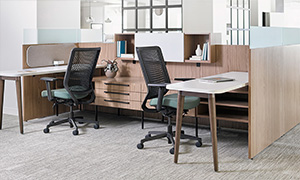
Cluttered walkways and poorly positioned furniture create tripping hazards, especially in high-traffic areas near entryways, break rooms, and shared equipment like printers and copiers. Cables running across floors or dangling behind desks introduce unnecessary risk that a clean cable management setup would eliminate. Drawers that open into walkways, chairs that roll into circulation paths, and storage units placed in tight corners all contribute to a workspace where bumps, trips, and strains happen regularly. These issues are preventable. The solution starts with recognizing that office design is a safety decision, not just an aesthetic one.
Evaluating Your Workspace Through a Safety Lens
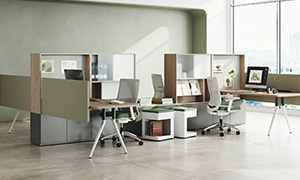
A safety-focused layout evaluation doesn’t require a complete redesign. It starts with walking the floor and observing how people actually move through the space. Look at circulation paths first. Are the primary routes between workstations, meeting rooms, and common areas clear and wide enough for comfortable two-way traffic? Narrow corridors created by oversized furniture or poorly placed partitions force employees into awkward movements and increase collision risk.
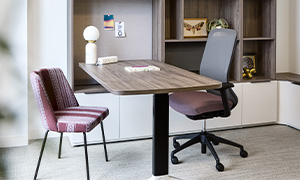
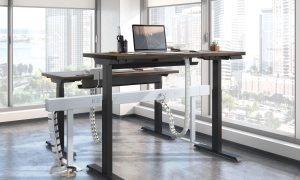
Next, examine workstation setups. Chairs that lack proper lumbar support or height adjustability contribute to chronic back and neck strain. Desks that sit too high or too low force employees into postures that create repetitive stress injuries over time. Monitor placement matters too. Screens positioned too far, too close, or at the wrong height lead to eye strain and neck tension that compound with every hour spent at the desk.
Then look at how technology connects to the workspace. Power cords, ethernet cables, and charging lines should route through integrated cable management systems. Furniture with built-in power access keeps workstations clean and functional while removing one of the most common trip hazards in office environments.
How National Safety Month Can Spark Lasting Change
The value of National Safety Month goes beyond a single awareness campaign. It’s an opportunity to establish habits and systems that keep employees safer all year long. Using June as a starting point, organizations create momentum for improvements that extend through the rest of the year.
Simple actions like repositioning furniture to widen walkways, replacing worn-out chairs that no longer provide proper support, or upgrading desks with integrated cable management can dramatically reduce daily risk. These changes don’t require shutting down operations. They require intention and a partner who understands how design decisions affect safety outcomes.
How D&R Office Works Builds Safety Into Every Project
D&R Office Works incorporates safety-minded planning into every workspace project as part of its comprehensive design process. Space planning begins with understanding how teams move through and interact with their environment. Our veteran design team accounts for traffic flow, ergonomic workstation setups, lighting, and furniture placement to create layouts that are functional, efficient, and safe.
Because D&R manages every phase in-house, including design, product selection, delivery, and installation, every detail stays connected. The designer who planned the circulation paths communicates directly with the installation crew executing it. That continuity is assurance that nothing gets lost between the plan and the space.
Every piece of furniture is assembled with precision by D&R’s in-house installation team, leveled, secured, and positioned according to the original layout. A comprehensive punch walk at the end of each project confirms that every element meets expectations and that the workspace performs as intended.
A Safer Office Starts With Smarter Design
National Safety Month is a reminder that protecting employees goes beyond policies and protocols. It includes the physical environment where people spend their working hours. When furniture, layout, and design choices are made with safety in mind, organizations create workspaces that support well-being, reduce injury risk, and perform better in every measurable way.
D&R Office Works helps organizations across Southern California build environments where safety and design work together. Connect with the team to discuss how your workspace can better protect your people.
