

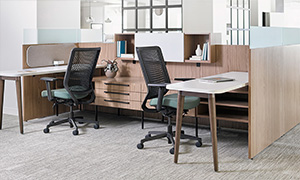
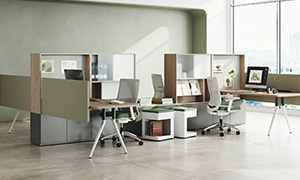
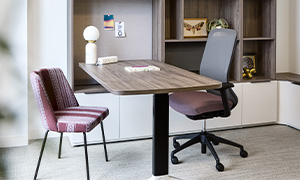
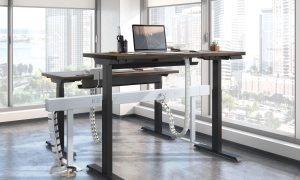


FF&E stands for furniture, fixtures, and equipment: the items in a space that aren’t permanently attached to the building. That’s the FF&E meaning most guides give, and many are written for hotels. On an office project, FF&E usually covers desks, workstations, seating, tables, and storage. It’s often budgeted apart from construction, and many leases let TI allowance cover it.
Clients often come to us assuming the construction budget already covers their furniture. It usually can, through the tenant improvement allowance, but only if someone plans for it. Otherwise, FF&E tends to surface late: after the build-out is priced, and close enough to move-in that lead times start to pinch. Below is what the term covers on an office project, how to budget for it, and when to start.
How Does the FF&E Meaning Change for an Office Project?
If you search “what is FF&E,” most answers describe a hotel: beds, lobby lounges, and dining chairs. In an office, the list looks more like this:
- Workstations and desks, including systems furniture: panel-based workstations that connect into runs and often carry power and data
- Task chairs, guest seating, and lounge seating
- Conference, training, and break room tables
- Filing cabinets, lockers, and other freestanding storage
- Reception desks and lobby furniture
- Equipment, depending on the contract: monitor arms, whiteboards, and break room appliances
What generally falls outside FF&E is anything built into the space: walls, flooring, ceilings, lighting, HVAC, built-in cabinetry, and the electrical and data cabling that runs to the furniture. Those belong to the construction scope.
The line between the two is where projects slip. Systems furniture is FF&E, but the power that feeds it often comes through a floor box or wall outlet installed by the electrical contractor. If the furniture plan isn’t settled before that work happens, outlets can land where no desk will ever sit. Putting the furniture plan in front of your contractor early is the simplest fix.
Can Your TI Allowance Pay for FF&E?
A tenant improvement (TI) allowance is money your landlord provides to build out or customize your space, usually stated per square foot in the lease. In our experience, most of our clients can put TI allowance toward furniture. The catch is that construction draws on the same allowance. If the build-out is priced first, it can use most of the money before anyone asks about furniture.
Leases differ on what the allowance covers, so read the TI section of yours or ask your broker before you plan around it. Questions worth asking:
- Can the allowance be applied to furniture, or only to construction?
- Is there a cap on how much can go to FF&E?
- Does furniture have to be delivered or installed by a certain date to qualify?
- Is the allowance paid to you as a reimbursement, or directly to vendors?
Once you have the answers, decide how the allowance splits between build-out and furniture before either budget is final.
How Do You Build an FF&E Budget?
- Count the people who need a workstation today, then the hires you expect over the next year or two. If 40 people move in this spring and you expect 55 by next year, plan the layout for 55. Adding workstations to an occupied floor later means a second delivery and a second install around people trying to work.
- Group items by room and category: workstations, seating, conference and training rooms, storage, reception, and break room. When a quote comes in high, each group can be adjusted on its own.
- Decide what you’re keeping. Reusing existing furniture can lower the line. We disassemble, transport, and reinstall furniture you’re keeping, and remove or recycle what you aren’t.
- Put delivery, installation, and project management in the first draft. Those lines can cover elevator reservations, the floor and wall protection your building requires, and the punch list walkthrough, and a product-only quote leaves them out.
- Set money aside for changes. Once people see the floor plan, someone will ask for a different chair or two more seats, and a contingency lets you say yes without reopening the budget approval.
Product choices usually move the number most. Our manufacturer partners span a range of styles, price points, and lead times, so the same layout can often be quoted at more than one level. If you’re weighing product lines, our guide to comparing commercial office furniture manufacturers walks through the questions to ask.
When Should FF&E Procurement Start?
FF&E procurement covers everything from specifying products to the final punch list: quoting, ordering, tracking lead times, receiving, delivery, and installation. A punch list is the list of small fixes and missing pieces caught in the final walkthrough.
Project timelines vary with scope, complexity, and manufacturer lead times. A small office refresh typically takes 4 to 6 weeks, and a full floor can take 8 to 12 weeks. Work backward from your move-in date and let the longest lead time set the start. Build-to-order items, like custom conference tables and large workstation runs, tend to set the pace.
If construction is involved, start earlier than the furniture timeline alone suggests. The furniture plan should be ready before electrical work begins, so power and data land where the desks go.
Public agencies often add a bid or approval step, and many set small business participation goals. D&R is a certified small business with the California Department of General Services, and your procurement office can confirm whether that certification applies to your goals.
Who Manages FF&E on an Office Project?
On a typical office project, FF&E changes hands several times. An architect or interior designer often writes the specifications, and the general contractor builds the walls, flooring, and power around them. The furniture dealer quotes the products, places the orders, and sends crews to deliver and install. Someone also has to keep those schedules in step, usually a project manager.
Picture the designer revising the furniture plan in week six. If that revision never reaches the electrician, the outlets go in where the old layout put the desks, and moving them after the walls close costs time and money that neither the construction budget nor the FF&E budget planned for.
At D&R, space planning, furniture, delivery, installation, and project management sit under one roof, and our own crews handle delivery and installation. One team owns the FF&E schedule from the first layout to the punch list. After installation, we service manufacturer warranties and handle claims directly.
What Should You Have Ready Before You Ask for an FF&E Quote?
You don’t need a finished design to start. These are enough for a useful first quote:
- A floor plan, even a rough one, with dimensions
- Your seat count today and what you expect in a year or two
- A budget range, and whether any TI allowance can go to furniture
- Your target installation or move-in date
- A list of furniture you plan to keep, move, or remove
- Any standards your organization requires, such as ANSI/BIFMA testing, GREENGUARD certification, or ADA work surface heights
We furnish offices across Los Angeles, Orange County, San Diego, Ventura County, and the Inland Empire. Send us your floor plan, budget range, and any TI allowance you can apply, and we’ll scope the FF&E.
